

PLAY(THE)GROUND:
Friendship and Collaboration
SUMMER RESIDENCIES IN QUINTA DA FONTE, QUINTA DO MOCHO, BAIRRO DO ZAMBUJAL AND TALUDE.
— project duration
June 1st 2025 - August 15th 2025
June 1st 2025 - August 15th 2025
— curatorial team
Lígia Fernandes
Aurélie d’Incau
Sara Husnjak
Lyuba Hrisimova
Lígia Fernandes
Aurélie d’Incau
Sara Husnjak
Lyuba Hrisimova
— contacts
Kenza Benbouchaib
Kenza Benbouchaib
— partner organization
AMRT – ASSOCIAÇÃO PARA A MUDANÇA E REPRESENTAÇÃO TRANSCULTURAL
COOPERACTIVA ALFRAGIDE
ASSOCIAÇÃO DE MORADORES A PARTILHA - BAIRRO DE ZAMBUJAL
AMRT – ASSOCIAÇÃO PARA A MUDANÇA E REPRESENTAÇÃO TRANSCULTURAL
COOPERACTIVA ALFRAGIDE
ASSOCIAÇÃO DE MORADORES A PARTILHA - BAIRRO DE ZAMBUJAL
— support
CÂMARA MUNICIPAL DE LOURES
MURO ATELIER
LISBON DRAWING CLUB
CÂMARA MUNICIPAL DE LOURES
MURO ATELIER
LISBON DRAWING CLUB
— support
communication
AFROLINK
communication
AFROLINK
“Djunta-mon”, a Cape Verdean and Guinean
Creole expression meaning “joining hands,” originates in rural contexts
and is rooted in a strong practice of mutual solidarity among friends,
relatives, and neighbors, enabling the creation and realization of
collective projects. As populations migrated to urban spaces abroad,
djunta-mon was adapted to address the socio-urban challenges of the
city, taking form in peripheral neighborhoods through mutual aid: group
efforts to clear land, open streets, care for neighbors’ children, or
help build houses, among others. This "[...] culture of origin continues
to have practical applications in the management of everyday problems
in new places of residence.” (Gallardo, 2014, p. 7) [1]
What can the peripheries of Lisbon teach us about friendship and collaboration?
What are the invisible bonds that connect the neighborhood to itself and to the rest of the city?
What modes of collaboration exist between humans and non-humans?
Is shared care a legacy of the past or a vision for the future?
What does “djunta-mon” mean, and how does it inhabit your body and actions?
What acts of affection can we find in the daily life of the neighborhoods?
What do friendship and collaboration mean to each community, neighbor, or culture, and to you?
In the outskirts of Lisbon, we find a diverse and plural city, where everyday life, solidarities, and creative processes intertwine, giving rise to new cultural expressions in constant transformation and (re)construction [1]. These neighborhoods, often perceived as opaque or isolated areas, reveal—upon closer observation—a rich web of collaboration and friendship that sustains daily life. These relationships arise either out of necessity or are inherited from traditions of mutual support and community.
In some self-built neighborhoods, communities come together to create, maintain shared spaces, and welcome newcomers. Here, collaboration and the sense of place develop organically. In other areas, particularly social housing or resettlement neighborhoods, the territory is assigned rather than chosen—making coexistence and friendship a process that must be learned.
In both cases, it is in the city’s margins that we find some of the most valuable lessons about the act of “joining hands.” That’s why we invite you to reflect on FRIENDSHIP and COLLABORATION as part of the PLAY(THE)GROUND summer edition of 2025.
What is PLAY(THE)GROUND?
PLAY(THE)GROUND is a multidisciplinary residency program aimed at individuals seeking space, focused time, and stimulating conversations that can help launch or develop a project rooted in a specific territory.
We welcome artists, curators, researchers, collectives, or anyone from other disciplines (e.g., gastronomy, sports, education, agriculture, architecture, anthropology, among others) interested in collaborative, experimental, and place-based work.
This residency offers a studio space in a specific urban environment, providing participants with the independence and freedom necessary for the development of a bottom-up project.
For the summer residency, we strongly encourage applicants who wish to collaborate with the younger population of the neighborhood, though other situated or socially engaged practices are also welcome.
The residency offers studio spaces, local mediation and mentoring, with the possibility to apply for a financial support.
In the summer of 2025, we are situated in the peripheries of Lisbon, and applicants can decide to work in different locations:
– Quinta da Fonte
A social housing neighborhood that brings together people displaced from other city neighborhoods, of different origins, such as Portuguese, Roma communities, and various African and Afro-descendant populations.
– Bairro do Talude
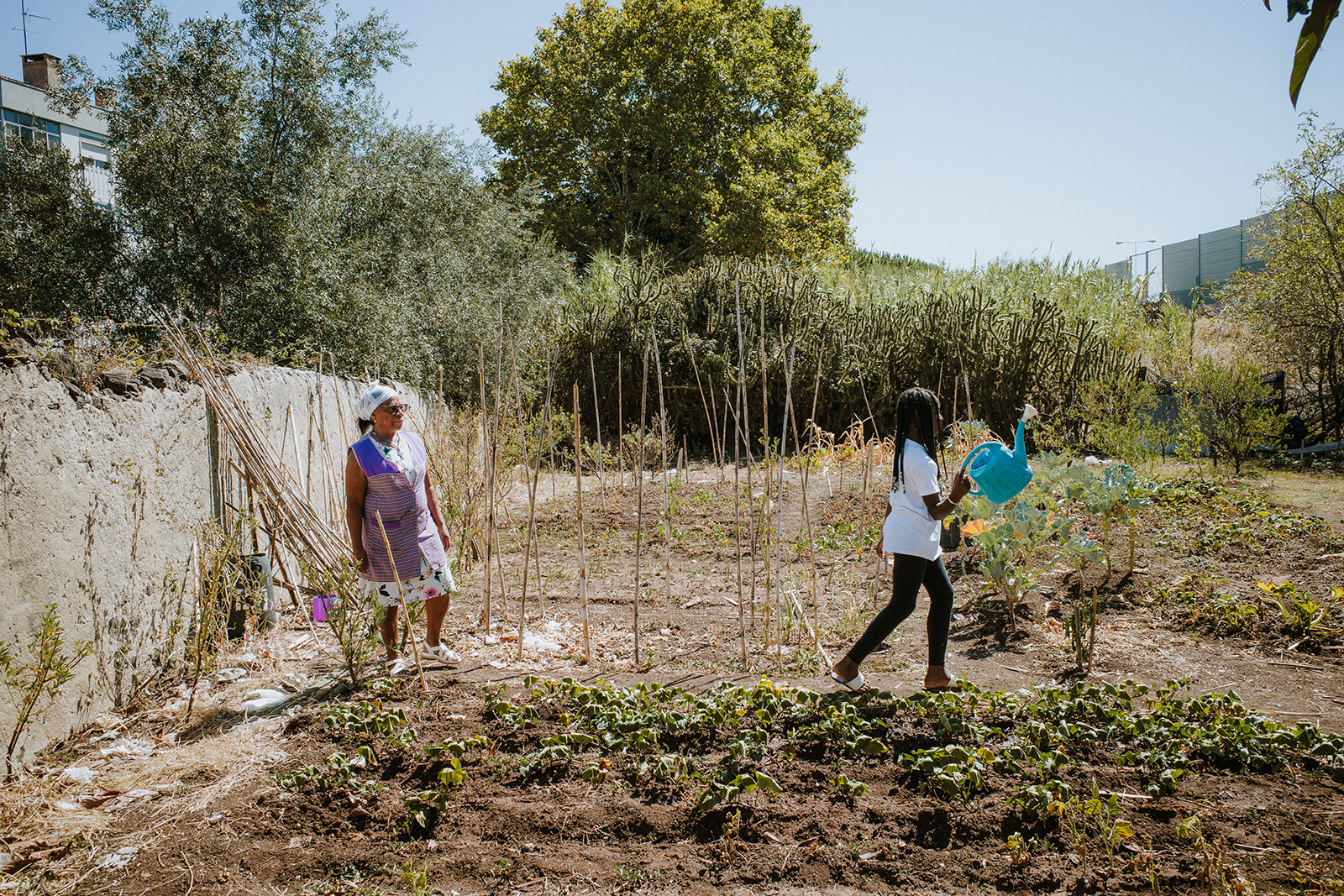
An informal self-built neighborhood, predominantly composed of families from Cape Verde. It has very little commerce, one restaurant, one bar, a "distillery," and many gardens created by the residents. It is an impermanent territory, planned to be demolished in the future for urban redevelopment purposes.
– Bairro do Zambujal
One of the largest social housing neighborhoods in Lisbon, located in Alfragide. It has a diverse population, including Portuguese, Roma communities, and various African and Afro-descendant populations. The studio here is located in the residents' association A PARTILHA, with the possibility of collaborating with activities and spaces for children developed by the association COOPERACTIVA.
– Quinta do Mocho
A social housing neighborhood situated in the parish of Sacavém, in the municipality of Loures. Originally built to relocate families from informal neighborhoods in Lisbon, it now hosts a diverse population, including people of Portuguese, African, and Afro-descendant origins, especially from countries like Cape Verde, Guinea-Bissau, Angola, and São Tomé and Príncipe.
What are the invisible bonds that connect the neighborhood to itself and to the rest of the city?
What modes of collaboration exist between humans and non-humans?
Is shared care a legacy of the past or a vision for the future?
What does “djunta-mon” mean, and how does it inhabit your body and actions?
What acts of affection can we find in the daily life of the neighborhoods?
What do friendship and collaboration mean to each community, neighbor, or culture, and to you?
In the outskirts of Lisbon, we find a diverse and plural city, where everyday life, solidarities, and creative processes intertwine, giving rise to new cultural expressions in constant transformation and (re)construction [1]. These neighborhoods, often perceived as opaque or isolated areas, reveal—upon closer observation—a rich web of collaboration and friendship that sustains daily life. These relationships arise either out of necessity or are inherited from traditions of mutual support and community.
In some self-built neighborhoods, communities come together to create, maintain shared spaces, and welcome newcomers. Here, collaboration and the sense of place develop organically. In other areas, particularly social housing or resettlement neighborhoods, the territory is assigned rather than chosen—making coexistence and friendship a process that must be learned.
In both cases, it is in the city’s margins that we find some of the most valuable lessons about the act of “joining hands.” That’s why we invite you to reflect on FRIENDSHIP and COLLABORATION as part of the PLAY(THE)GROUND summer edition of 2025.
What is PLAY(THE)GROUND?
PLAY(THE)GROUND is a multidisciplinary residency program aimed at individuals seeking space, focused time, and stimulating conversations that can help launch or develop a project rooted in a specific territory.
We welcome artists, curators, researchers, collectives, or anyone from other disciplines (e.g., gastronomy, sports, education, agriculture, architecture, anthropology, among others) interested in collaborative, experimental, and place-based work.
This residency offers a studio space in a specific urban environment, providing participants with the independence and freedom necessary for the development of a bottom-up project.
For the summer residency, we strongly encourage applicants who wish to collaborate with the younger population of the neighborhood, though other situated or socially engaged practices are also welcome.
The residency offers studio spaces, local mediation and mentoring, with the possibility to apply for a financial support.
In the summer of 2025, we are situated in the peripheries of Lisbon, and applicants can decide to work in different locations:
– Quinta da Fonte
A social housing neighborhood that brings together people displaced from other city neighborhoods, of different origins, such as Portuguese, Roma communities, and various African and Afro-descendant populations.
– Bairro do Talude
An informal self-built neighborhood, predominantly composed of families from Cape Verde. It has very little commerce, one restaurant, one bar, a "distillery," and many gardens created by the residents. It is an impermanent territory, planned to be demolished in the future for urban redevelopment purposes.
– Bairro do Zambujal
One of the largest social housing neighborhoods in Lisbon, located in Alfragide. It has a diverse population, including Portuguese, Roma communities, and various African and Afro-descendant populations. The studio here is located in the residents' association A PARTILHA, with the possibility of collaborating with activities and spaces for children developed by the association COOPERACTIVA.
– Quinta do Mocho
A social housing neighborhood situated in the parish of Sacavém, in the municipality of Loures. Originally built to relocate families from informal neighborhoods in Lisbon, it now hosts a diverse population, including people of Portuguese, African, and Afro-descendant origins, especially from countries like Cape Verde, Guinea-Bissau, Angola, and São Tomé and Príncipe.